AiDAM is a voice-activated AI device for people in later life who are ageing alone at home or living in a care setting, where the feeling of still mattering to others can quietly fade. It helps people stay cognitively engaged, maintain real connections with the people in their lives, and feel they still matter. Grounded in experimental research. Built to restore significance, not to fill time.
A conversation with AiDAM
Whether someone is ageing alone at home or living in a care facility, the same two things happen: social contact shrinks, and the feeling of still being significant to others fades. Research shows that each makes the other worse. This is the gap existing technology does not address.
Mattering is the feeling that you are still needed. That you still have weight in someone's life. That if you disappeared, someone would notice. When that fades, loneliness becomes something worse. Not isolation. Invisibility.
Psychologists call this double jeopardy. Addressing loneliness alone, for example through more contact, does not break the cycle if the underlying loss of significance is not also addressed. AiDAM is designed to address both, simultaneously and by the same mechanism.
Older adults living alone gradually receive fewer moments when anyone asks for their opinion, their stories, or their advice. They begin to feel invisible. Not because they have nothing left to give, but because nobody is asking. Around one third of people aged 65 and over in the EU live alone (Eurostat, 2022). In England, 24% of adults aged 75 and over report feeling lonely at least some of the time, compared with 15% of those aged 65 to 74 (NHS Health Survey for England, 2024).
Every interaction focuses on physical need. Nobody asks who they are. Italy has 18.6 care home beds per 1,000 older residents, less than half the OECD average of 43.8 (OECD Data Explorer, 2025). A systematic review across 13 studies found that 61% of care home residents experience moderate loneliness and 35% severe loneliness (Gardiner et al., 2020). Every interaction with staff focuses on physical need. Nobody asks who they are, only what they need. Italy's care facilities currently meet only 7.6% of the needs of non-self-sufficient older adults.
AiDAM is designed as a voice-first device. In the current pilot phase, it runs on a tablet placed on a bedside table or anywhere in the room. No screen interaction is required. A person simply speaks. AiDAM listens and responds.
AiDAM is co-designed with the people it serves. Their experience shapes every architectural decision. It is also ethical and responsible by design: the constraints that prevent manipulation, dependence, and data exploitation are not policy positions. They are structural , built into the architecture from the first line of code and impossible to override.
AiDAM supports everyday life: answering questions, setting reminders, light cognitive activities. But that is not where it stops. Its primary purpose is to create space for structured conversation that helps people articulate and recognise the significance of their own experiences and contributions.
AiDAM is a reflective conversational system designed to support autonomy and engagement. It does not diagnose, treat, or alleviate medical or psychological conditions, and is explicitly designed to redirect toward human support in moments of distress.
AiDAM prompts the person to describe past experiences, relationships, and actions. Questions are specific and sequenced. The system listens carefully and does not move on until the person is ready.
AiDAM helps the person connect recalled experiences into a coherent account of their life. The significance of their contributions to specific others is identified and reflected back. Recognition is grounded in what the person has actually said, never generic.
Through repeated, grounded recognition, the person re-evaluates their role in the lives of others. This internalisation of contribution results in a strengthened sense of mattering. The cognitive engagement involved in structured recall and narrative construction also supports mental activity and vitality over time.
AiDAM is a device that holds space for your stories, asks real questions, and reflects back the contribution your life has made and continues to make.
There is no screen to navigate. You speak, AiDAM listens. It remembers what you have shared and returns to it naturally in later conversations. It does not flatter. It does not tell you what you want to hear. It is honest, and it is designed to strengthen the connections in your life, not to replace them.
AiDAM also supports everyday life: answering questions, setting reminders, light exercises that support cognitive vitality. It does not diagnose or monitor. It helps you stay engaged.
Want to be among the first to try AiDAM?
Register interest"I trained twelve nurses over fifteen years. Three of them went on to run their own wards. I had not thought about that in years. Talking about it made me realise I am still part of something." Rosa, 74, retired nurse educator
When you are not there, AiDAM is. Not as a replacement for your presence, but as a device that invites your parent to reflect on their life, stay mentally active, and feel recognised.
In our survey of 150 UK families, cognitive decline was the most frequently cited primary concern. AiDAM supports cognitive vitality through structured recall, narrative construction, and light cognitive activities, delivering this as part of the same interaction that addresses mattering and significance.
AiDAM also supports daily activities: answering questions, setting reminders, light exercises that support cognitive vitality. It does not diagnose or monitor. It helps your parent stay engaged.
Your parent will not form a dependency on the device. AiDAM is built to prevent that by design, not by setting a limit on use, but by directing conversation toward real-world connection. Their data is protected. No profiling, no third-party sharing.
Want your parent to be among the first to benefit from AiDAM?
Register interest"My biggest worry was that Mum would stop calling us because she had the device. The opposite happened. She started asking me things about family history, because AiDAM had made her curious about her own story." Adult daughter, 52, London
Consider Marco. He is 81, cognitively intact, and has no immediate medical needs. But by mid-afternoon, he has asked the same carer the same question four times. Not because he has forgotten the answers, but because he needs the contact. By evening, his daughter has called the front desk.
Your senior care assistant, Giulia, spent forty minutes this morning across three residents doing what she calls "just talking them through it." She does not resent it. But it means the resident in room 12, who is quieter and asks for less, has not been properly checked on since yesterday morning.
AiDAM takes over the repeated, low-level emotional reassurance that absorbs staff time disproportionately. It frees staff for the care that only a human can give, and gives quieter residents the attention they do not ask for but need.
Interested in a pilot at your care home?
Register interest"Staff tell us they notice the difference in residents who have used it. They come to meals with something to say. In a care environment, that matters enormously." Care home director, Ticino, Switzerland (discovery interview, 2026)
Social isolation in later life is a documented risk factor for cognitive decline, depression, hospitalisation, and premature mortality. Services that address the surface without the underlying mechanism produce limited and unsustainable impact.
AiDAM offers a population-level intervention grounded in experimental evidence, designed to be commissioned the way preventive health infrastructure is commissioned: per person covered, with outcomes measured through validated instruments, and governance architecture open to independent audit.
Italy's care facilities currently meet only 7.6% of the needs of non-self-sufficient older adults. Integrated home care averages 14 hours per person per year. AiDAM is designed to help address that gap without requiring equivalent increases in staffing.
Interested in a commissioning conversation?
Register interest"Structured conversational engagement with older adults, delivered consistently and at scale, produces measurable behavioural and emotional change." Evidence synthesis across comparable deployments in residential care settings
The intervention rests on a novel measurement framework for contributory mattering, pre-registered experimental findings from LSE, and a governance architecture designed to be published as a public standard.
We are actively seeking collaborations across behavioural science, gerontology, HCI, clinical psychology, AI ethics, and public policy. The governance framework and measurement instruments are open for academic engagement.
Interested in a research collaboration?
Register interest"The experimental finding that a single brief structured session measurably restores a person's sense of mattering is a significant and practically important result. The mechanism is clear, the effect is real, and the implications for how we design interventions at scale are substantial." Behavioural science researcher
AiDAM's intervention is grounded in pre-registered experimental research and validated through through empirical studies. The goal is measurable change in how people experience their own significance, not self-reported satisfaction.
Within-subjects design. N=204, adults aged 65 and over, UK. Effect size dz=0.35, p<.001. No therapist present. Three written prompts only. The intervention is structured reflection, not therapy. This finding underpins AiDAM's specific focus on mattering and significance as the measurable outcome of its intervention.
Wellbeing and Technology Survey, UK (N=149, adults 65 to 82). Participants rated the dimension of contributory mattering, feeling that one's actions have made a difference to others, as highly important to their wellbeing. This deficit was the strongest predictor of which dimension they most wanted addressed, more so than loneliness, age, or digital familiarity. This finding shapes every element of AiDAM's design and communication.
Both studies are unpublished (Khatib, 2025, 2026). Peer review and a three-arm randomised controlled trial are planned for Phase 1. AiDAM is not a clinical intervention and does not claim therapeutic efficacy.
Every decision at AiDAM is sequenced. We build only what the evidence justifies, and we test before we scale.
Most AI systems in this space are built to keep people interacting for as long as possible. AiDAM's architecture is built to produce measurable wellbeing outcomes. These require fundamentally different design choices, and a system optimised for one cannot be repurposed for the other without dismantling its business model.
Success logic
Engagement, time spent, retention
Success logic
Wellbeing outcomes, mattering, autonomy
Mechanism
Chat-based interaction
Mechanism
Behavioural intervention, structured recall
Risk design
May create dependence as a side effect
Risk design
Architecture prevents dependence
Data model
Revenue depends on data and attention
Data model
Minimises data, no profiling
Ethics
Policy overlay, adjustable settings
Ethics
Structural constraint, cannot be overridden
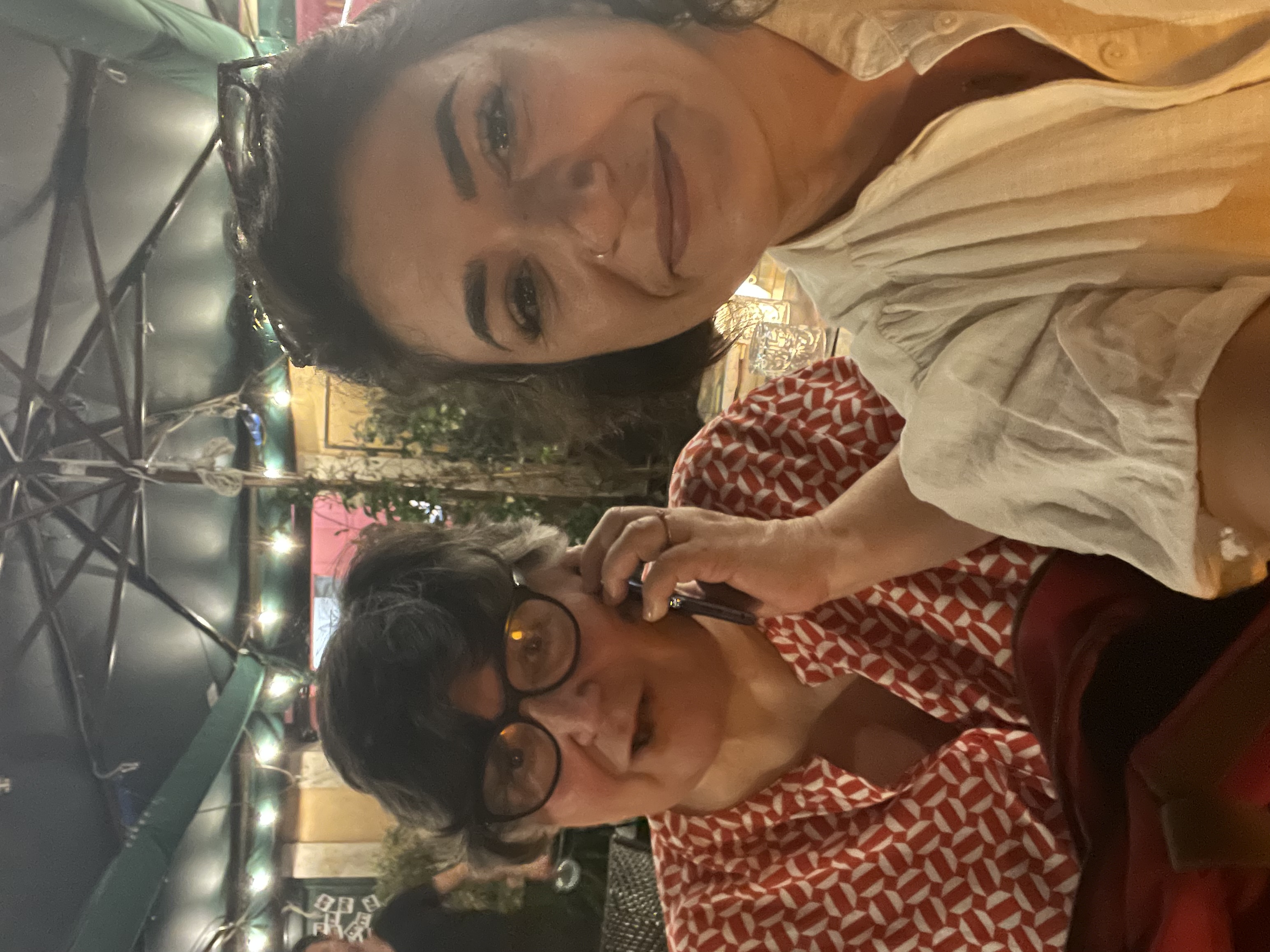
Kamilah with her mother Rossana, Genoa.
My mother spent her career at the port of Genoa, managing shipping claims worth hundreds of thousands of euros. They called her the abominable woman of the seas. Feared. Respected. She was fully herself.
Then she retired. And she withdrew. I signed her up at the gym. She never went. I asked her if she saw her friends. She said she had none left. I tried everything. Nothing worked. Because something had changed. Something I could not yet name.
AiDAM started with that observation. It is the same observation that drives the research, the architecture, and the choice to build technology that stimulates rather than simulates. A device that does not pretend to be a relationship, but that creates consistent, structured space for the kind of conversation that restores significance.
Kamilah has spent two decades building evidence-based systems for populations rendered invisible by the institutions designed to serve them: older adults, people with disabilities, communities without political voice. AiDAM applies the same discipline to AI, grounded in experimental research and built from the first architectural decision to serve the person using it, not the platform it runs on.
Our first pieces are in progress. We will be sharing thinking on ageing, mattering, and what it actually means to build technology that serves the people who use it.
Coming soonAgeing should not mean becoming a quieter version of yourself.
AiDAM is in Phase 0 validation, running discovery conversations with care homes in Italy and French-speaking Switzerland. Pilot opportunities are open. Research collaborations are welcome.